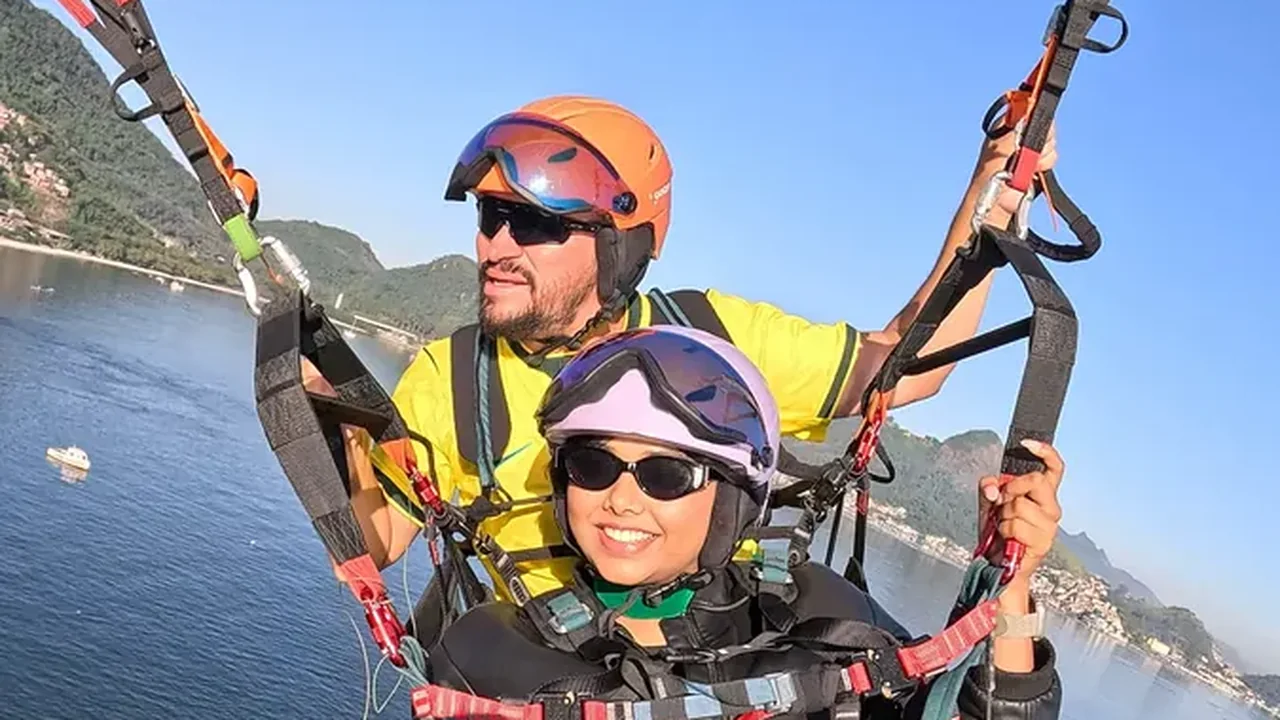
What can go wrong on a tandem paragliding flight? The real scenarios are few and well known: a partial wing collapse, an equipment failure, a change in the wind, an aborted take-off and the passenger feeling unwell. Every one of them has a protocol, and when something does not line up the usual outcome is not an accident: it is the flight not happening that day.
Almost every article about paragliding answers "is it safe?" with a yes and a list of credentials. This one does the opposite: it names what can go wrong, one by one, and shows what is already handled before you reach the ramp.
Why talk about what can go wrong
Talking about what can go wrong is what separates a serious school from a sales pitch. Anyone promising zero risk in an air sport is hiding something, and people who have flown spot it immediately.
Paragliding is a sport of controlled risk. The risk exists, as it does in almost any outdoor activity, and it is managed with method. The difference between a good operation and a bad one is not the absence of problems: it is having a protocol ready for each of them.
On a tandem flight that protocol sits entirely with the instructor. You do not assess the wind, you do not pick the moment to launch and you make no technical decision at all. It is worth knowing what happens behind the scenes, and that is what follows.
💡 This article goes deeper than is paragliding safe?, which covers the topic at the level of credentials and equipment. Here we go down to the concrete scenario.
The eight scenarios and what is already handled
Eight situations cover virtually everything people imagine when they picture a tandem paragliding flight. The table below pairs each one with its protocol.
| Scenario | Why it worries people | What is already handled | Outcome |
|---|---|---|---|
| The wing collapsing in the air | It is the image everyone carries: the wing folds and you fall. | The tandem wing is certified and chosen for slow, predictable reactions. A partial collapse reopens on its own most of the time, and the instructor corrects it with the brakes before it becomes anything. | Expected |
| The equipment failing | A carabiner, buckle or stitching giving way mid-flight. | Every carabiner and buckle is checked one by one before each take-off. The wing goes through line, fabric and seam inspections, and the reserve parachute is repacked within its interval. | Checked |
| The wind changing after take-off | Starting out fine and turning mid-flight. | The instructor does not launch without a window that has margin. The flight lasts 10 to 20 minutes precisely so it fits inside a stable condition, and the landing approach is planned with room to spare from the start. | With margin |
| Freezing during the run | Stumbling or braking in the middle of the take-off run. | If the run is not clean, the instructor aborts and you both walk back. There is no half take-off: either it goes right, or it does not go. | Aborts |
| Feeling unwell in the air | Nausea, dizziness or sudden discomfort during the flight. | Tell the instructor the moment you feel it. The flight is cut short and the approach starts right away. That is why we ask you to declare any health condition before heading up to the ramp. | Flight cut short |
| The instructor feeling unwell | The question almost nobody asks out loud. | A tandem flight is run by a single licensed pilot, which is exactly why his condition matters so much. He does not fly ill, medicated or tired, and the call not to fly that day is his alone. | No flight |
| Rain or gusts moving in | The weather closing in while you are getting ready. | The reading is continuous, not a one-off. If the picture changes before take-off, the flight is postponed. If it changes with you already airborne, the approach is brought forward. | Postpone or land early |
| Not flying at all that day | Travelling, driving up the hill and going home without flying. | It is the most common outcome when something does not line up, and that is by design. Rescheduling is free and you pick another date. Losing the day beats flying in a doubtful condition. | Reschedule |
Look at the pattern in the last column: in most rows, the outcome of a problem is not an accident. It is the flight being postponed, cut short or aborted. That is the distinction that almost never shows up when you search for paragliding risk.
The collapsing wing: fear number one
A wing collapse is the scenario that looms largest for people who have never flown, and it is also the most misunderstood. The wing is not loose fabric: it takes shape from the air entering the front and stays inflated as long as it keeps moving forward.
Turbulence can cause a partial collapse, where part of the tip folds inward. On a certified tandem wing, sized for two occupants, the expected behaviour is to reopen by itself within seconds. The instructor usually corrects it with the brakes before you even notice.
There is also the reserve parachute, a second, independent system the instructor knows when and how to deploy. It is a last resort, not routine. That is the difference between the two: the wing resolves it, the reserve exists for when it does not.
What happens when the weather turns
Weather turning is the most frequent reason a flight does not happen, and the reading is not done once. It is continuous: the day before, on arrival at the ramp, and in the minutes before the run.
- It changed before take-off: the flight is postponed, either to another slot the same day or to another date.
- It changed with you already airborne: the landing approach is brought forward and the flight is shorter than planned.
- The wind turned east: there is no take-off from the Parque da Cidade ramp. The detail is in wind conditions for paragliding in Niterói.
In all three cases rescheduling is free. You do not lose what you paid and you choose a new date. That policy exists so the decision to fly never depends on commercial pressure.
What depends on you
Most of the protocol does not depend on you, but three things do, and they are the ones that most affect how comfortable the flight feels.
- Declaring your health conditions. Heart problems, recent surgery, spine, knee or shoulder injuries, epilepsy, vertigo or pregnancy need to be flagged beforehand. Telling us rarely rules out the flight: it lets us adapt the take-off and the landing.
- Following the instruction on the run. A few steps forward, eyes ahead, no braking and no sitting down. It is the only moment where you have an active role.
- Wearing closed shoes. Flip-flops and sandals come off at take-off and landing. See what to wear for paragliding.
None of this requires fitness. The tandem flight takes passengers from 20 to 110 kg, with no upper age limit and no experience, as we explain in who can go paragliding.
The risk that cannot be removed
There is a residual risk no honest school promises to erase. Paragliding is an air sport and, like every air sport, it is not risk free. That part has to be said plainly.
What can be stated responsibly is that this risk falls consistently when four things are in place: a certified, inspected wing, a reserve repacked on schedule, a licensed instructor and absolute respect for the conditions of the day.
We deliberately do not quote accident statistics here. Numbers out of context either frighten or mislead, and almost every figure in circulation refers to solo flying, by a pilot deciding alone, not to tandem flying run by a professional. They are different realities.
How to assess any school, including ours
You do not have to take anyone's word for it: you can check. Use this list on any operation, here or in São Conrado.
- Ask for the instructor's licence. CBVL tandem certification and ANAC registration as an air sports pilot (RBAC 103). A serious school answers without hesitating.
- Ask about the reserve. When it was last repacked is a legitimate question.
- Listen to what they say about weather. If the answer is "we fly in any conditions", be wary.
- Check the reputation. Real reviews and years in operation. Linhares Fly is rated 5.0 on Google from 73 reviews, with more than 19 years on the ramp.
- Insist on a briefing. Before take-off you should get clear instructions on launching and landing.
A price well below the market usually means one of those items was cut. The price comparison is in how much paragliding costs in Niterói.
In short
What can go wrong on a tandem paragliding flight fits on a short list, and every item on it has a protocol ready. Most of the time, the outcome of a problem is the flight not happening, not an accident.
The flight leaves the Parque da Cidade ramp in Niterói, at around 270 metres of altitude, lasts 10 to 20 minutes and costs from R$ 379, with photos, video and insurance included. If this text left a question unanswered, ask it: that is exactly what the WhatsApp is for.
📚 References (Wikipedia): paragliding · Niterói
Still have a question this text did not answer?
Ask the person who flies you. Tandem flights from R$ 379, with photos and video included and free rescheduling.
💬 Message us on WhatsApp