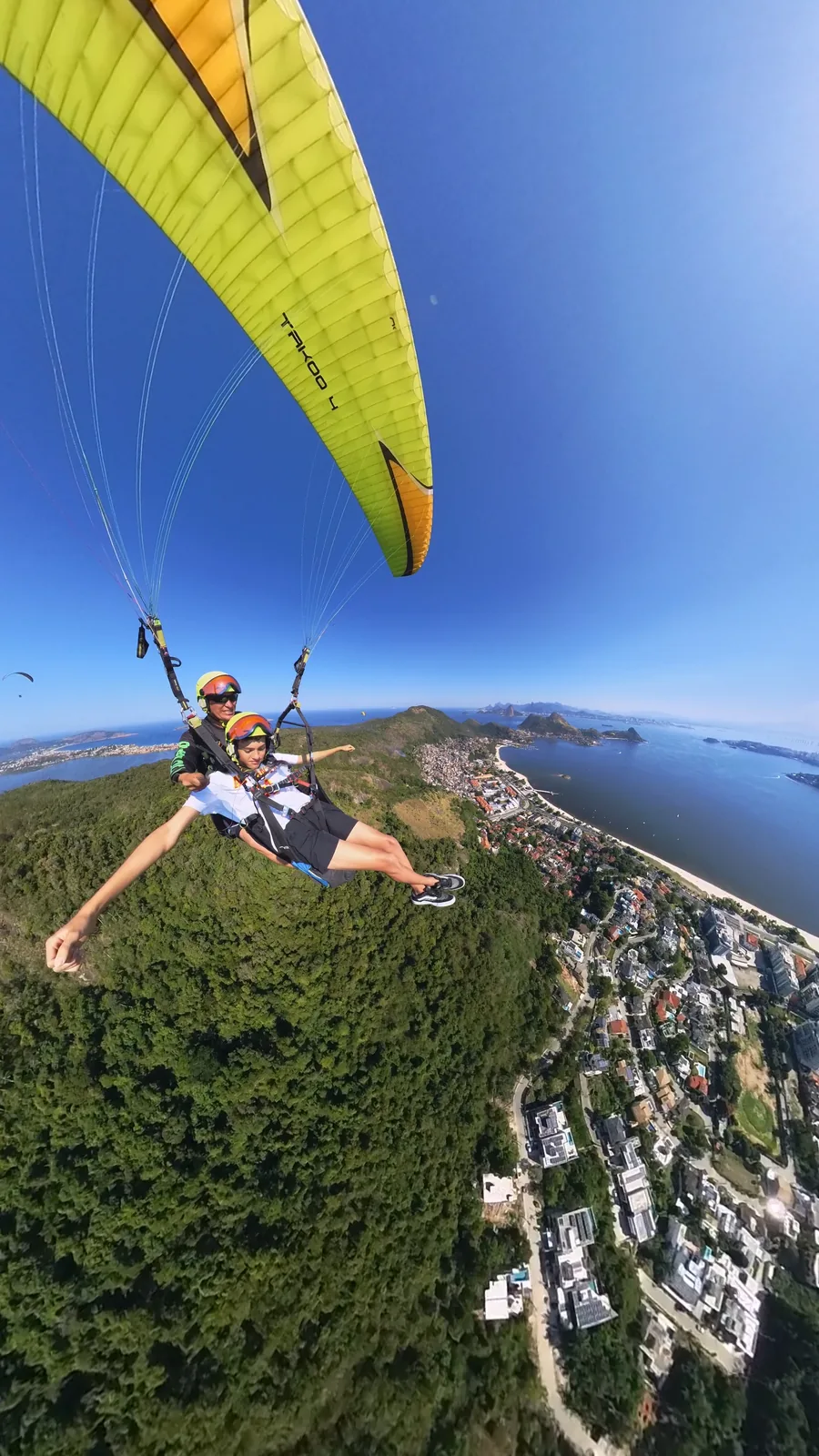
What is the best wind for paragliding in Niterói? The best winds at the Parque da Cidade ramp in Niterói are north and south. North-east, north-west, west, south-west and south-east also allow flying, depending on the strength and stability of the day. East is the only wind that stops take-off.
Wind is the one variable that decides whether your flight happens, at what time and how it feels. Understanding how it behaves at the Parque da Cidade ramp helps you pick the best date and arrive relaxed on the day of your tandem paragliding flight.
Why the wind decides a paragliding flight
Wind decides a paragliding flight because it is what inflates the wing and holds everything up. With no engine, a paraglider depends entirely on the air it finds at take-off and throughout the flight.
Three factors go into that reading, always together. Direction determines whether the wind comes straight into the Parque da Cidade ramp in Niterói, or arrives from behind it. Strength has to sit inside a working range: too light will not lift the wing, too strong removes the safety margin. Stability tells us whether that wind holds steady or keeps breaking into gusts.
A perfect direction with the wrong strength does not fly, just as a strong, steady wind can be better than a light, gusty one. It is the combination of all three that defines the day.
💡 Visiting Rio de Janeiro? Most people compare the two ramps before booking. The full guide to paragliding in Rio de Janeiro covers the differences in view, access and price between São Conrado and Niterói.
Wind rose for the Parque da Cidade ramp
The Parque da Cidade ramp in Niterói, at around 270 metres of altitude, works well with seven of the eight wind directions. North and south are the best, five directions are possible depending on the day, and only east stops take-off.
| Wind direction | Status on the ramp | What it means for your flight |
|---|---|---|
| North (N) | Best | Comes straight into the ramp and gives clean lift. This is the condition that most often produces a calm, predictable tandem flight. |
| North-east (NE) | Possible | Flies when the strength helps and the air is stable. Your instructor reads the ramp before laying out the wing. |
| East (E) | No flight | Arrives from behind the ramp and prevents take-off. We wait for the wind to turn or reschedule at no cost. |
| South-east (SE) | Possible | Depends on the strength of the day. It often opens good windows when the air is clean and free of gusts. |
| South (S) | Best | Another direction coming straight into the ramp, with a smooth take-off and good lift over Guanabara Bay. |
| South-west (SW) | Possible | Flies in moderate strength. Gusts or instability push take-off back. |
| West (W) | Possible | Allows flying on part of the days. The reading on the ramp at your booked time decides it. |
| North-west (NW) | Possible | Usually gives a good flight when it blows steadily, without sharp changes in strength. |
Notice how long the list of possible directions is. In practice that means the Parque da Cidade ramp has plenty of good windows across the year, and a day only becomes unworkable when the wind turns east or when strength and stability fall outside the working range.
Types of wind and how each one feels in the air
The same wind can produce very different sensations during a flight. What changes is the behaviour of the air, and four behaviours show up most often at the Parque da Cidade ramp in Niterói.
| Behaviour | What it is | How it feels in the air | When it happens | Status |
|---|---|---|---|---|
| Laminar wind | Air moving in layers, steady in both direction and strength. | A smooth, quiet flight, with the feeling of gliding over the landscape. | Common in the early morning and late afternoon, when the ground is cooler. | Ideal |
| Thermal | A column of warm air that rises as the sun heats the ground. | Small bumps and a gain in altitude, like a gentle lift. | From mid-morning to mid-afternoon, mainly in summer. | Flies well |
| Calm | No wind, or wind too light to hold the wing up. | Nothing happens, because take-off never gets off the ground. | On high-pressure days with still air, often around midday. | Wait for a window |
| Gusts and cold fronts | Wind that changes strength within seconds, or an unstable air mass moving in. | You do not feel it, because the flight does not happen in this condition. | During frontal passages and on unstable afternoons, in any season. | No flight |
Thermals sound alarming, but they are exactly what makes longer flights with altitude gain possible. What your instructor assesses before take-off is not whether thermals exist, but how strong they are at the time of your flight.
Will you fly today? The decision flowchart
The decision to fly runs through three checks made on the Parque da Cidade ramp itself, always in this order: direction, strength and stability. A single failed check is enough to push take-off back.
- Is the wind from the east? If yes, the flight does not happen: we wait for the wind to turn during the day, or reschedule at no cost. If no, we move to the next check.
- Is the strength within range, neither too light nor too strong? If no, we wait for a better window later the same day, because conditions often shift within a few hours. If yes, we move on.
- Is the air stable, with no gusts, rain or mist? If no, we reschedule at no cost and you choose a new date. If yes, you take off for a flight of 10 to 20 minutes.
The full experience takes 1 to 2 hours, counting arrival, harness and helmet, the safety briefing and the wait for the best window. The tandem flight starts at R$ 379, with photos, video and insurance included, and rescheduling for weather never costs anything. The breakdown is in how much paragliding costs in Niterói.
Best time of day for each type of wind
The best time of day to go paragliding in Niterói depends on the kind of flight you want. Early morning gives the most stable air, midday brings the thermals, and late afternoon combines calm air with the best light.
| Time of day | How the air behaves | Who it suits |
|---|---|---|
| Morning | The most stable air, with laminar wind and little turbulence. | Anyone on a first tandem paragliding flight who wants the smoothest experience. |
| Midday | Active thermals, with rising air and a more dynamic flight. | Anyone looking for more movement who is already comfortable with heights. |
| Late afternoon | The air settles again and the light turns golden over Guanabara Bay. | Anyone who wants the best photos and video of the flight. |
If this is your first flight, the morning is the most comfortable choice, and it still leaves the afternoon free as a backup if the wind does not cooperate. The step-by-step of the experience is in your first tandem paragliding flight, step by step.
The season also changes how often good windows appear. The month-by-month reading is in the guide to the best time to go paragliding in Niterói.
How to follow the wind before booking
You can follow the wind at the Parque da Cidade ramp before you even book, through two direct routes. Neither one requires any technical knowledge of meteorology.
- Live conditions widget: the Linhares Fly home page shows live flight conditions, with a wind reading applied to our ramp. It is the quickest way to get a sense of the day.
- WhatsApp: if in doubt, message us on +55 21 97656-8366. We watch the ramp closely and can tell you, from local experience, whether the window looks promising.
A forecast is a probability, not a certainty. A day that looked closed sometimes opens a perfect window late in the afternoon, which is why the final confirmation always happens on the day itself, reading the real conditions on the ramp.
That reading is done by pilots registered with ANAC as air sports pilots (RBAC 103) and certified by CBVL for tandem flight, with more than 19 years of experience and over 5,000 flights from the Parque da Cidade ramp.
📚 References (Wikipedia): paragliding · wind · Niterói
Let us find your wind window
Tell us the date you have in mind and we will check wind direction, strength and stability on the ramp. Tandem flights from R$ 379, with photos and video included and free rescheduling.
💬 Book on WhatsApp