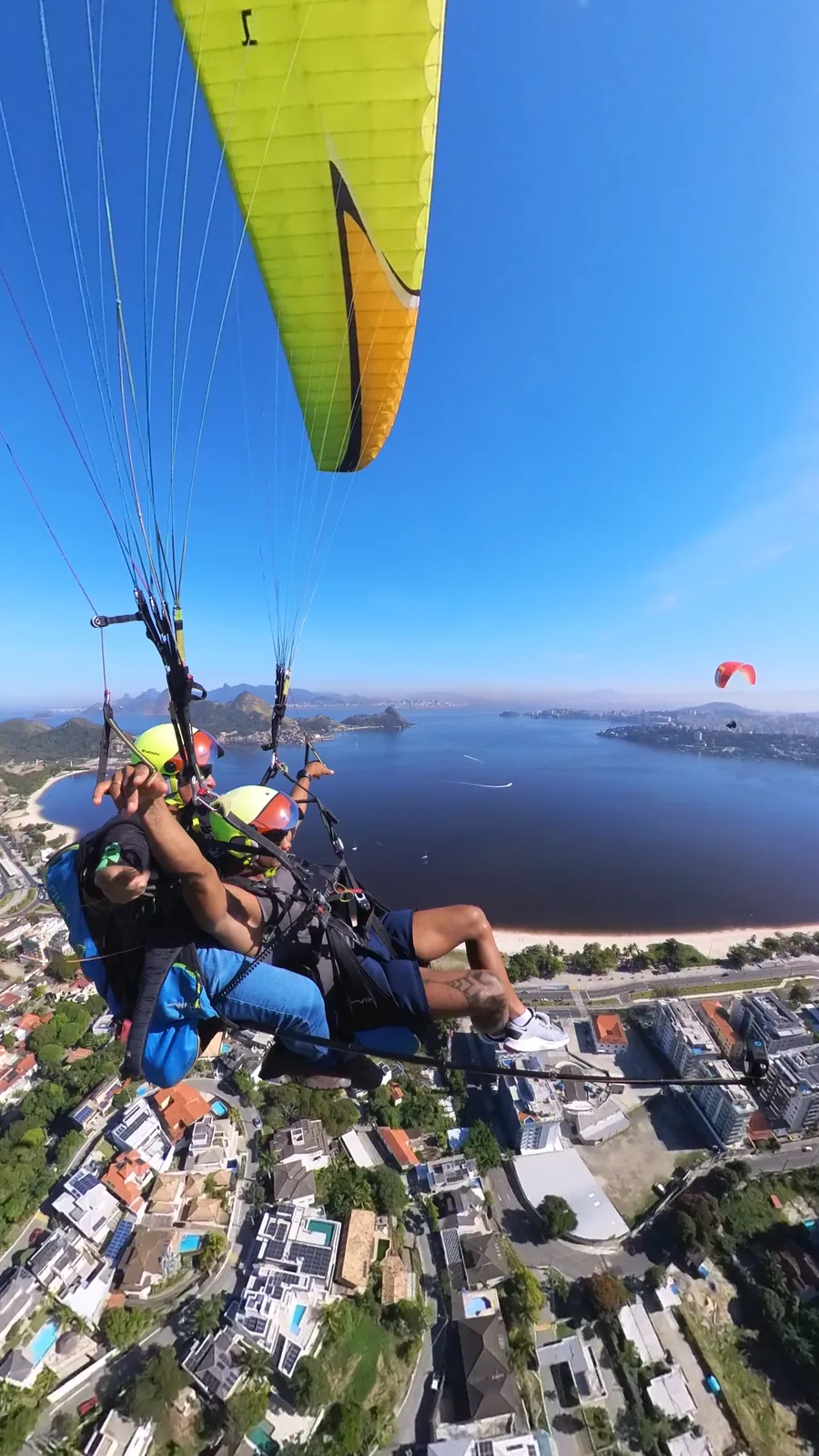
About to go paragliding for the first time and feeling that mix of nerves and excitement? Relax. Here is exactly how a tandem flight works, from the moment you arrive at the ramp to the soft landing — so you get there knowing what to expect.
First of all: you need no experience
On a tandem flight you are attached to a certified instructor who handles the entire operation of the wing. No special fitness, no knowledge of flying — just the willingness to try. Everything technical, from reading the wind to steering the canopy, is the job of someone who has been doing it for more than 19 years.
In practice your role is simple: follow three or four instructions at the right moment and, the rest of the time, enjoy the view. That is why tandem paragliding is one of the most accessible ways to fulfil the dream of flying — no course, no licence and no risk of "doing something wrong" up there.
💡 Visitors in Rio usually compare the two ramps before booking. In Niterói there is no separate club fee and the photos and video are already included. The details are in the guide to paragliding in Rio de Janeiro.
Who can fly: weight, age and health
- Weight: from 20 to 110 kg. The range is wide on purpose, to safely take everyone from children to larger adults.
- Age: there is no maximum age. Children and teenagers fly accompanied and authorised by a parent or guardian.
- Health: you do not need to be an athlete. Still, if you have any health condition, are pregnant, had recent surgery or have back, heart or mobility issues, tell the team before the flight so the instructor can adapt the take-off and landing.
Not sure about your case? Message us before booking. The full details are in who can go paragliding.
Step 1: Arrival at the ramp
You are welcomed at the Parque da Cidade ramp in Niterói. This is the moment to meet the team, ask questions and take in the view from the lookout. Arrive with a few minutes to spare: it helps to breathe, watch the flights ahead of yours and settle into the mood without rushing.
Meanwhile the instructor is watching the wind. Paragliding depends on the weather, and safety always comes before the clock: if the wind is not right, the flight is rescheduled. That wait is part of the sport — and it is a good sign.
Step 2: Safety briefing
The instructor explains, in plain words, what is going to happen and what you should do. There are basically three instructions:
- Keep your posture upright at launch.
- Walk or run a few steps when he tells you to.
- Sit into the harness only after he says so.
It sounds like very little, and it is. The briefing is short on purpose: the simpler it is, the easier to remember in the moment. Use it to ask everything — from "what if I freeze?" to "can I take my phone?". There are no silly questions, and leaving with no doubts is what helps most.
Is it normal to feel afraid?
Completely. That flutter at the edge of the ramp happens to almost everyone, including people who love adrenaline. The body simply reacts to the unknown. The good news is that it disappears seconds after your feet leave the ground, when the feeling turns into lightness and silence.
- Breathe slowly in the moments before the command. Controlled breathing genuinely calms the body.
- Trust the process. You are attached to an experienced instructor and to equipment checked item by item.
- Do not hold your breath or close your eyes at launch. Looking at the horizon takes the focus away from the drop.
- Say it out loud. Tell the instructor how you feel — he knows how to fly with nervous passengers.
Step 3: Getting geared up
You put on the harness and helmet. The instructor checks every buckle and connects you to the equipment with full attention. He will often check things more than once, and that is a good thing: redundancy is part of the routine of any well-run flight. The harness is comfortable, like a suspended armchair. If anything feels tight, say so before you go up.
Step 4: The launch
With the wing inflated, the instructor gives the command and you take a few firm steps. Within seconds your feet leave the ground — smoothly, with no jolt. There is no drop: the wing gains lift and simply takes you off the ground, as if the hill were sinking away beneath you.
👀 Tip: at launch, look at the horizon, not at the ground. It helps your posture and lets you enjoy the instant you start flying.
What not to do: do not sit down early (the number one beginner mistake), do not stop mid-stride, do not look down or try to see the wing over your shoulder, do not grab the straps or the instructor, and do not try to "help" steer. The flying is his job; the walking is yours.
Step 5: The flight
Now you simply enjoy it. For 10 to 20 minutes you glide over Niterói with a view of Christ the Redeemer, Sugarloaf and Guanabara Bay. The instructor can fly smoothly or add livelier turns — just say what you prefer. If you feel queasy or want a calmer flight, say so too; everything can be adapted.
This is where most people understand why free flight wins them over. Without an engine, the silence is surprising: you can talk in a normal voice, hear the wind and look at the city from an angle few people ever see. Save a few seconds to look around without a camera — that memory stays.
Step 6: The landing
The approach is calm and the landing is soft. The instructor does everything; you only need to stretch your legs forward to touch down on your feet. He warns you in advance, so there is no surprise. Most of the time you take one or two little steps and that is it — no impact, no shock.
Tips for the day
- Clothing and shoes: comfortable clothes and, above all, closed shoes. No flip-flops. More in what to wear for paragliding.
- Eat lightly: avoid a heavy meal just before, but do not fly on an empty stomach.
- Bring sunscreen, sunglasses and water. The ramp is outdoors and waiting for conditions is part of it.
- Allow slack in your schedule: the flight depends on the wind and may run late.
- Secure loose items. Caps, glasses and phones must be fastened.
After the flight: photos, video and the feeling
At the end you receive the photos and the video of your flight, already included in the price. More than the record, what usually stays is the feeling: that mix of calm and euphoria that only people who have flown understand. It is common to walk off the landing field with a grin that will not go away — and already thinking about the next time.
📚 References (Wikipedia): paragliding · Guanabara Bay
Ready for your first flight?
No experience needed. Tandem flights from the Parque da Cidade ramp in Niterói, from R$ 379, with photos and video included.
💬 Book on WhatsApp