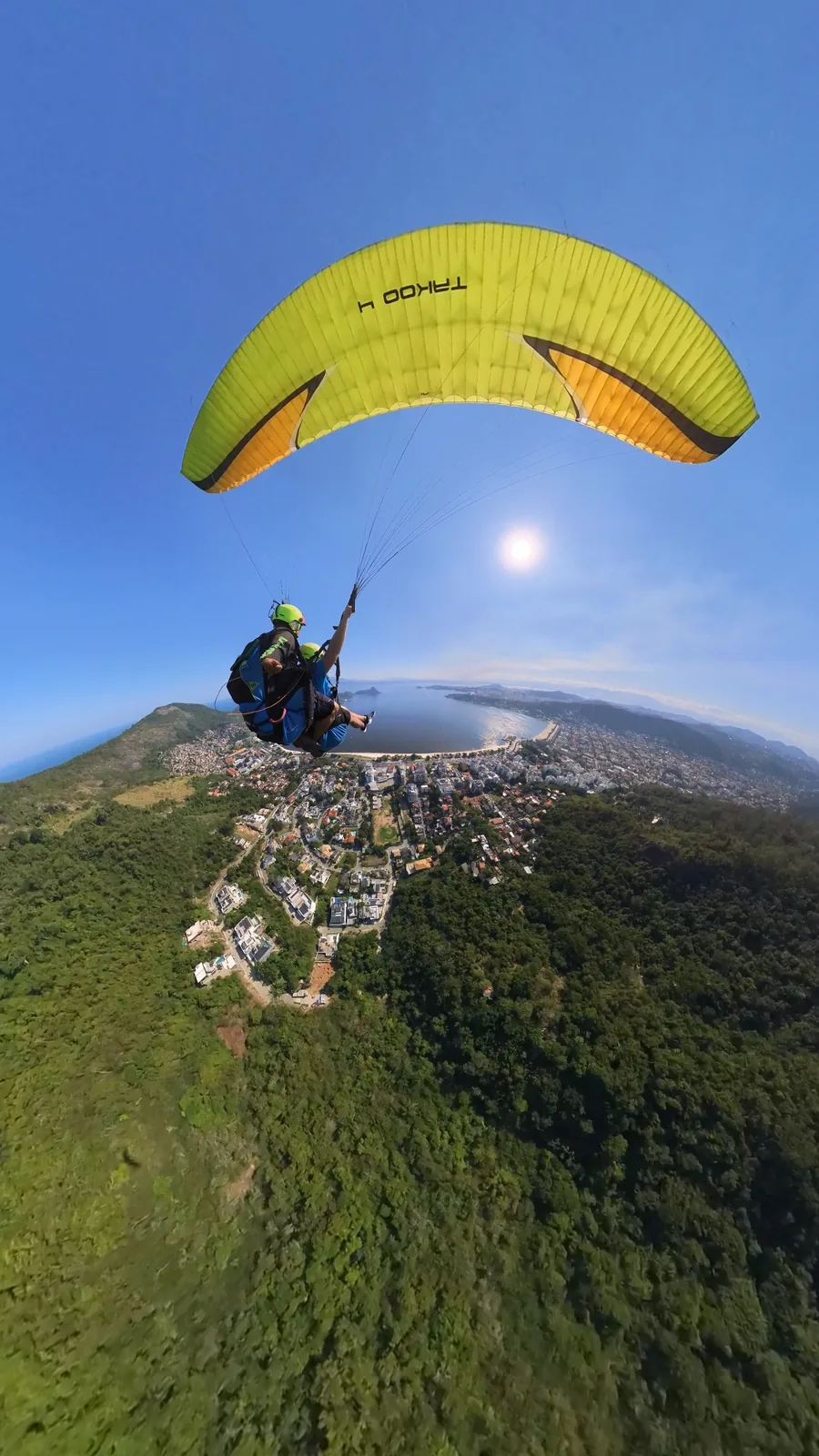
If you searched for a "paragliding jump", here is the short answer: in paragliding there is no jump. You do not leap off anything — you launch by running a few steps with the wing already open above your head, and you glide away smoothly. Jumping belongs to skydiving, which is a different sport.
Why so many people say "jump"
It is one of the most common searches from people who have never flown, and it makes sense. The mental image most of us have is of someone throwing themselves off something high: the ramp is in the photo, the ground is far below, and the brain fills in the rest of the scene with a leap.
There is nothing wrong with that. We hear "I want to do a paragliding jump" almost every day, and we know exactly what people mean: the experience of leaving the ramp and seeing Niterói and Rio from above. The popular term works.
You launch, you do not jump
It is worth describing exactly what happens on the ramp, because that is where the difference becomes clear. The wing is laid out on the ground behind you. The instructor clips the harness, checks the carabiners and gives the briefing. When the wind comes in nicely, he inflates the wing: the fabric fills with air and rises above you, and it is already flying while your feet are still on the ground.
Only then comes the launch. The instructor gives the word and you take a few firm steps down the slope — usually three, four or five, depending on the wind. With each step the wing carries more weight, until it simply takes over: your feet stop touching the ground and you are flying.
That is the technical difference in a sentence: in paragliding the wing is flying before you are. At no point in the experience is there free fall — not at launch, not during the flight, not on the approach to land.
Skydiving versus paragliding
| Paragliding flight | Skydive | |
|---|---|---|
| How it starts | Launch by running a few steps, wing already inflated | Jump from an aircraft in flight |
| Free fall | None at any moment | Yes, before the canopy opens |
| Starting height | Ramp at about 270 m, on Morro da Viração | Thousands of metres, reached by plane |
| Time in the air | 10 to 20 minutes | A few minutes |
| Sensation | Gliding, silence, time to look around | Intense adrenaline of the fall |
Neither is better than the other — they simply deliver different things. If what you want is the wind on your face while Guanabara Bay drifts slowly below, with time for photos and conversation, paragliding is your sport. If you want the rush of free fall, that is skydiving.
About the height: 270 metres may sound modest next to a skydive, but the perception in the air is very different from the number. Because the flight happens close to the terrain and the shoreline, you see everything clearly — the sea, the beaches, the city.
And hang gliding? Also not a jump
Hang gliding belongs to the same family as paragliding: it is free flight, it launches from a ramp and it has no free fall either. The difference is the structure — a hang glider has a rigid frame and the pilot flies lying down, while a paraglider is a flexible wing and you fly seated. The full comparison is in paragliding, hang gliding and skydiving.
So can I call it a jump?
Call it whatever you like. If you message us saying "I want to do a paragliding jump in Niterói", we will know exactly what you mean and book your flight without blinking. The only thing that matters is expectation: if you arrive imagining free fall, you will miss it, because it does not come. What arrives instead is the lightness of gliding and the surprising calm of being in the air.
What your "jump" actually looks like in Niterói
- Arrival and preparation: you meet the instructor at the ramp, put on the harness and helmet and get a short, clear briefing.
- Waiting for the right moment: the instructor watches the wind and picks the window.
- The wing inflates above you, with your feet still on the ground.
- The launch: a few firm steps down the slope and your feet leave the ground — no jump, no drop.
- The flight: 10 to 20 minutes gliding, with Guanabara Bay, Sugarloaf and Christ the Redeemer in view. Photos and video included.
- The landing: a smooth approach in São Francisco, usually seated in the harness or with a couple of steps.
The tandem flight starts at R$ 379, takes passengers from about 20 to 110 kg and requires no experience or fitness.
Is it scary?
Almost everyone feels butterflies in the seconds before launch — that is normal. The good news is that it does not last: because there is no jump and no fall, the body never gets the shock it was bracing for. What helps most is knowing that you do not have to decide anything. There is no moment where someone says "go now" and you have to find the courage to throw yourself off. That instant, the most feared in any jumping sport, simply does not exist in paragliding. If fear of heights is your main concern, read fear of heights: can you still fly?.
📚 References (Wikipedia): paragliding · skydiving
Call it whatever you like — then come and fly
Tandem flights from the Parque da Cidade ramp in Niterói: 10 to 20 minutes gliding, from R$ 379, photos and video included.
💬 Book on WhatsApp