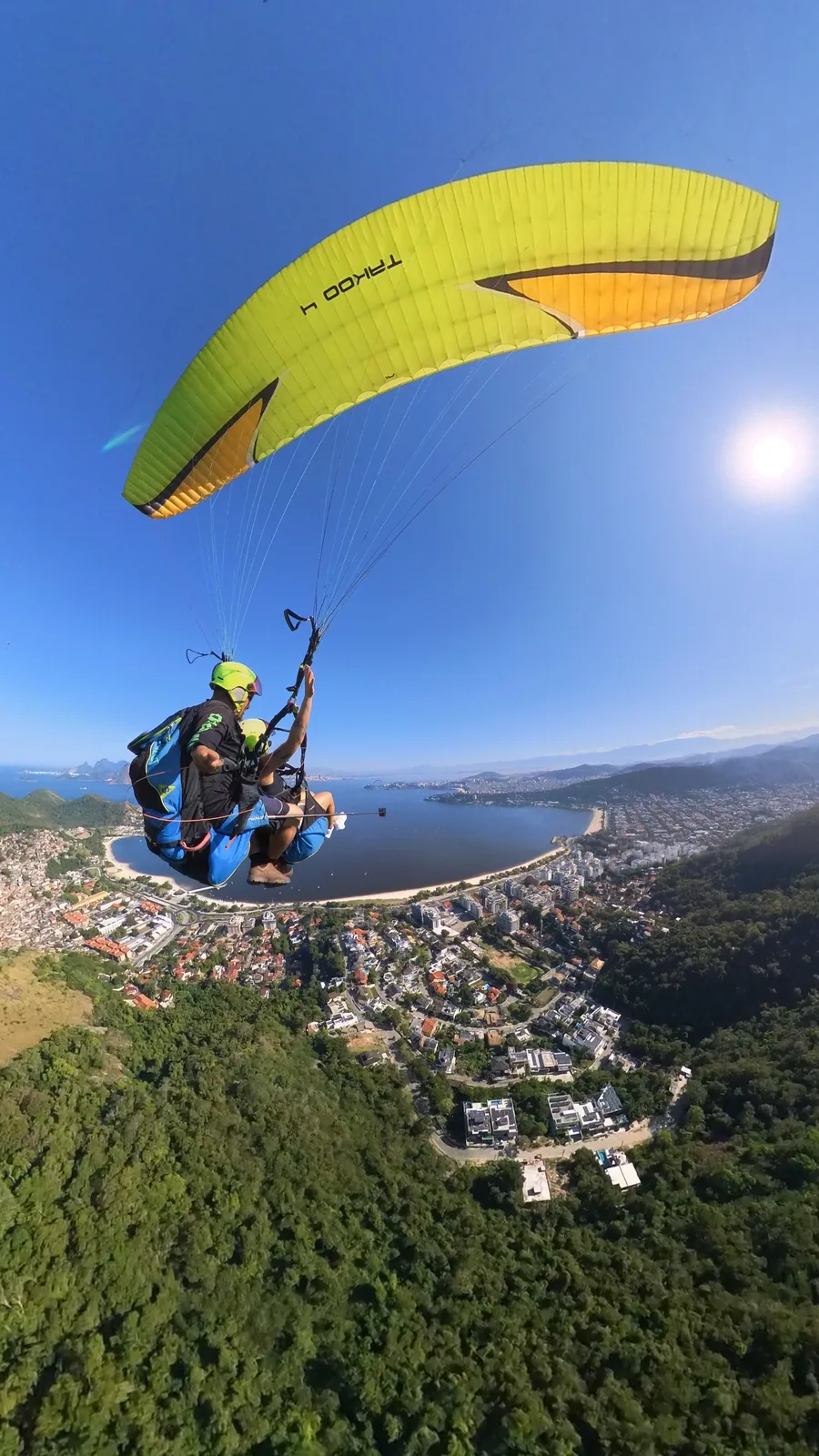
If you are afraid of heights but have always dreamed of flying, here is the honest answer: most people with a fear of heights can go paragliding — and love it. It sounds contradictory, but the sensation up there is very different from the knot in your stomach at the edge of a tall building.
Fear of heights is not fear of paragliding
It is a very common question: "if I freeze just looking down an escalator, how am I going to fly?". The truth is that fear of heights and fear of paragliding are different things. Many people who arrive at the ramp saying they are terrified of heights walk away wanting to fly again. It is not magic or superhuman courage — the body simply does not react the same way when it is floating.
We do not promise to cure any phobia, and everyone is different. But after nearly two decades of flying, the pattern repeats itself: the typical discomfort of height rarely shows up in a paraglider.
Why paragliding does not trigger the usual vertigo
For most people, fear of heights needs a specific trigger: a visible edge and the sense that you could fall. On a balcony or at the top of a ladder your eyes see the edge, your feet feel firm support and the brain raises the alarm. In a tandem flight those triggers practically disappear:
- There is no edge. After take-off there is no "ground right there" with a rim for the brain to fix on. Height becomes landscape rather than danger.
- The sensation is floating and gliding, not falling. The wing holds you smoothly, in a continuous, silent movement closer to sliding than to hanging over a drop.
- Your body is supported in the harness, comfortable as a suspended armchair, secured by equipment checked item by item and connected to the instructor.
That is why we so often hear: "I expected that awful drop feeling and it never came". Curiously, great height tends to bother people less than a small height with a visible edge.
What you actually feel
At launch, you take a few firm steps on the instructor's command and, within seconds, your feet leave the ground — no jolt, no drop. The wing gains lift and it feels as if the ground is sinking slowly away. Any initial flutter fades within seconds.
In the air comes the good surprise: silence, lightness and a breathtaking view of Niterói, with Christ the Redeemer, Sugarloaf and Guanabara Bay. This is where most people relax completely. You can talk to the instructor in a normal voice the whole time.
At landing, the approach is calm. The instructor warns you in advance and you simply stretch your legs to touch down gently. Many people do not even notice they have landed.
Tips for the nerves
- Breathe slowly in the moments before the command — controlled breathing genuinely calms the body.
- Look at the horizon instead of down. It greatly reduces any sense of vertigo.
- Talk to the instructor. Tell him you are afraid of heights; he knows how to fly with nervous passengers and will adjust the flight to you.
- Ask for a gentle flight. Tight turns are optional. A calm, scenic ride is perfectly fine.
Remember that fear and excitement produce almost identical reactions in the body. Often what feels like dread is just the good adrenaline of anticipation.
The instructor does everything
This is the point that reassures nervous passengers most. On a tandem flight you fly attached to a CBVL-certified instructor who handles absolutely all the controls: reading the wind, the launch, flying the wing and the landing. No experience, course or special fitness is needed. Your part is to follow three or four simple instructions and enjoy the view. You cannot "do it wrong", because the technical side is not in your hands.
What if I regret it mid-flight?
A fair worry. First, it almost never happens — any discomfort usually passes in the first seconds after take-off, exactly when the sensation turns into floating. Second, if nerves do hit, the instructor notices immediately and adapts: smoother turns, conversation to settle you and, if needed, a shorter flight and an earlier approach to land. You are never alone, and you never lose control of the situation, because the control is his from start to finish.
Who can fly and how to book
Tandem flying is broad and requires no experience. To check weight, age and health conditions before deciding, see who can go paragliding. The flight lasts 10 to 20 minutes from the Parque da Cidade ramp in Niterói and starts at R$ 379, with gentle take-off and landing. If any doubt remains, tell the team you are afraid of heights and ask everything you need — leaving with no doubts is what helps most.
📚 References (Wikipedia): acrophobia · paragliding
Tell us you are nervous — it helps
Passengers who say they are afraid of heights get a calmer flight, smoother turns and more time to settle in. From R$ 379, photos and video included.
💬 Book on WhatsApp